Larrean
The Calamitous BobLarrean is the fabled city of gods perched on the highest hill of an almost unscalable mountain, a place where ordinary measures of time, species, architecture, and political power cease to hold. Its decisive significance lies in the claim that whoever controls Larrean controls the world, making the city both a destination of religious wonder and the ultimate seat of sovereignty.
Setting and Approach
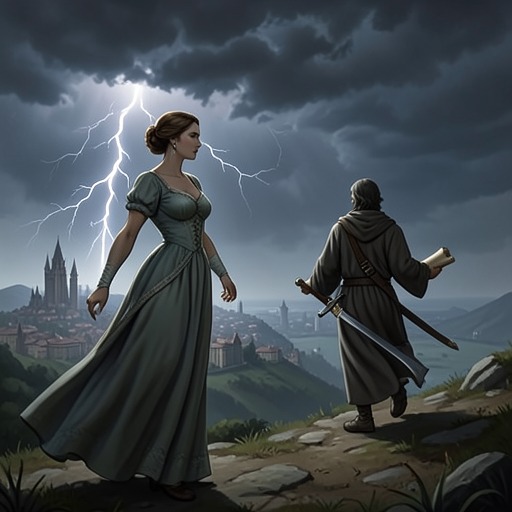
Larrean stands at the summit of a mountain of impossible height. Vertical cliffs of permafrost rise through magical gales powerful enough to scour flesh from bone, while grumpy wyrms and ancient elementals occupy the cavernous depths. Despite those hazards, travelers attempt the ascent every year for a single purpose: to glimpse the city. The journey therefore frames Larrean as an object of longing whose remoteness is itself part of its power.
The city is not merely difficult to reach; it is presented as a domain beyond ordinary human scale. Within Larrean, a stroll may last moments or eons, and spirits walk alongside beings as old as time. That distortion of duration places the city outside mundane chronology, while the yearly attempts to reach it connect the timeless divine realm to the persistent, repetitive striving of mortal explorers.
Architecture and Atmosphere
Larrean combines incompatible forms of life and construction. Temples of marble and gold stand beside eldritch structures made from shells and bones; coral walls surround crystal towers and obsidian keeps. Its air shifts from the scent of spring to brine and the sensation of a kiss by the sea with every step, giving the city an atmosphere that changes as rapidly as its architecture.
The city’s splendor is inseparable from its exclusivity. Only the mightiest can tread there, and a soul may be sold for a moment within it. This exchange turns access to Larrean into a literal economy of sacrifice: the city offers experiences of immeasurable value, but its threshold demands a corresponding surrender. Beauty, danger, and exploitation are therefore not separate features of the setting but parts of the same divine geography.
The Apex Palace and Sovereignty
The one constant amid Larrean’s dizzying variation is the Apex Palace, located on the city’s highest hill. It houses the throne of the ruling monarch and guards its position with ferocious zeal. The palace gives Larrean a stable political center within an otherwise shifting and heterogeneous metropolis.
The relationship between city and throne is absolute. Control of Larrean means control of the world, so the Apex Palace is more than a royal residence: it is the architectural expression of global sovereignty. The city’s sacred magnificence thus has a hard political underside. Whoever possesses its summit possesses the authority that all other powers must reckon with.
Contrast with the Deadlands
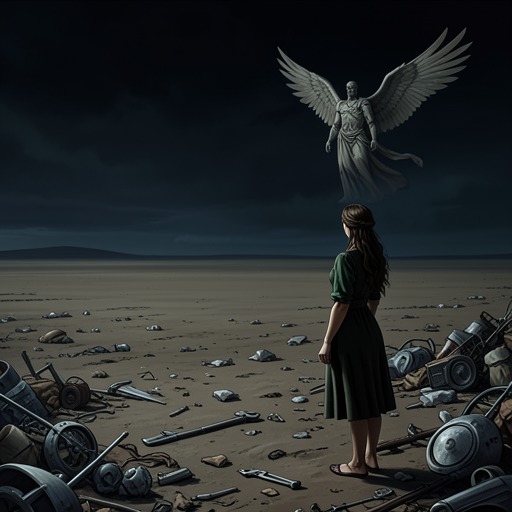
Larrean’s divine abundance is sharply contrasted by the ruined western region of Param, where the Old Empire once established its seat of power. That former imperial center is now a dead city of planned estates, temples, churches, and squares surrounded by basaltic desert, its rubble scattered for miles and its pyramid destroyed from within by a crater of extraordinary scale. The contrast does not make Larrean merely a beautiful opposite; it places the city within a larger history of civilizations that rise toward impossible power and can be broken at their height.
The distinction is also spatial and moral. Larrean remains the living summit of authority, while the old imperial landscape has become a corpse walked only by mindless undead. The ruined center preserves the material traces of magical greatness, whereas Larrean embodies continuing dominion. Together, the two spaces establish a recurring tension between divine permanence and imperial collapse.
Place in the Wider World
Although Larrean is introduced as the world’s political and sacred center, later geographical discussions place the known mortal regions within a more complicated network. Param is a large circular continent connected to its only neighbor by a narrow isthmus; Baran lies at the far eastern end, and Kazar belongs to Enoria, a kingdom fractured after a civil war fifteen years earlier. The Kark are undergoing hardships, while the Pure League has formed among northern free cities. These details do not diminish Larrean’s supremacy, but they show how distant and fragmented the mortal periphery is from the city that supposedly commands the world.
The same wider geography contains the Deadlands, where necromancers have destroyed nearby forts and where the Church of Neriad pays for Revenant heads, drawing mercenaries toward expeditions. Against this frontier of ruined forts, undead bodies, church authority, and investigative scrutiny, Larrean functions as the imagined center of order and transcendence. Its grandeur is therefore meaningful partly because so much of the surrounding world is defined by catastrophe, contested borders, and unstable power.